 |
|
Diagnostics for large battery cells and modules: From lab EIS to industrial decisions
Modern battery cells can look identical in capacity and 1kHz ACIR — but still behave differently under dynamic load. In this webinar, we will show real EIS data, a practical EV Formula battery case study, and how impedance analysis can support better industrial decisions.
The full webinar recording is now available on-demand.
Enter your details below to get instant access to the video.

The Hidden Risk
Beyond 1 kHz ACIR: What a single number can miss
Conventional battery testers measure only ACIR at a single frequency of 1 kHz. Doing so passes critical degradation unobserved, risking safety liabilities and leaving performance gains on the table. Additionally, a frequency of 1 kHz is not suitable and accurate for large battery cells.
Chemical Blind Spot
A single 1 kHz measurement completely ignores slow charge-transfer kinetics and fails to capture low-frequency ion diffusion processes.
Low Capacity Correlation
ACIR at 1 kHz shows a correlation of less than 30% with actual capacity, making it a poor proxy for real battery State-of-Health.
Unfit for Large Format
High-capacity cells (like LFP) require 100–250 Hz as the ideal ACIR frequency. At 1 kHz, parasitic inductance and proximity/skin effects dominate the signal.
The Solution
Full Spectrum EIS: The Internal Fingerprint of Your Cell
Upgrading from a basic tester to Kolibrik technology is not just about gaining decimals; it is a fundamental shift in how you understand your batteries. We provide the internal fingerprint of the cell.
Isolate Specific Defects
Differentiate between mechanical failure (high freq.), SEI degradation (mid freq.), and lithium-ion diffusion limits (low freq.).
Lithium Plating Prevention
Obtain early warning signatures of dendrite formation before internal micro-short circuits occur.
EIS-Based Thermal Fingerprinting
Use temperature-sensitive impedance features to estimate relative cell temperature changes and detect non-uniformity in battery modules.
Advanced EIS Techniques
High-speed production testing using Multi-sine & PRBS excitation for End-of-Line quality control and rapid module grading.
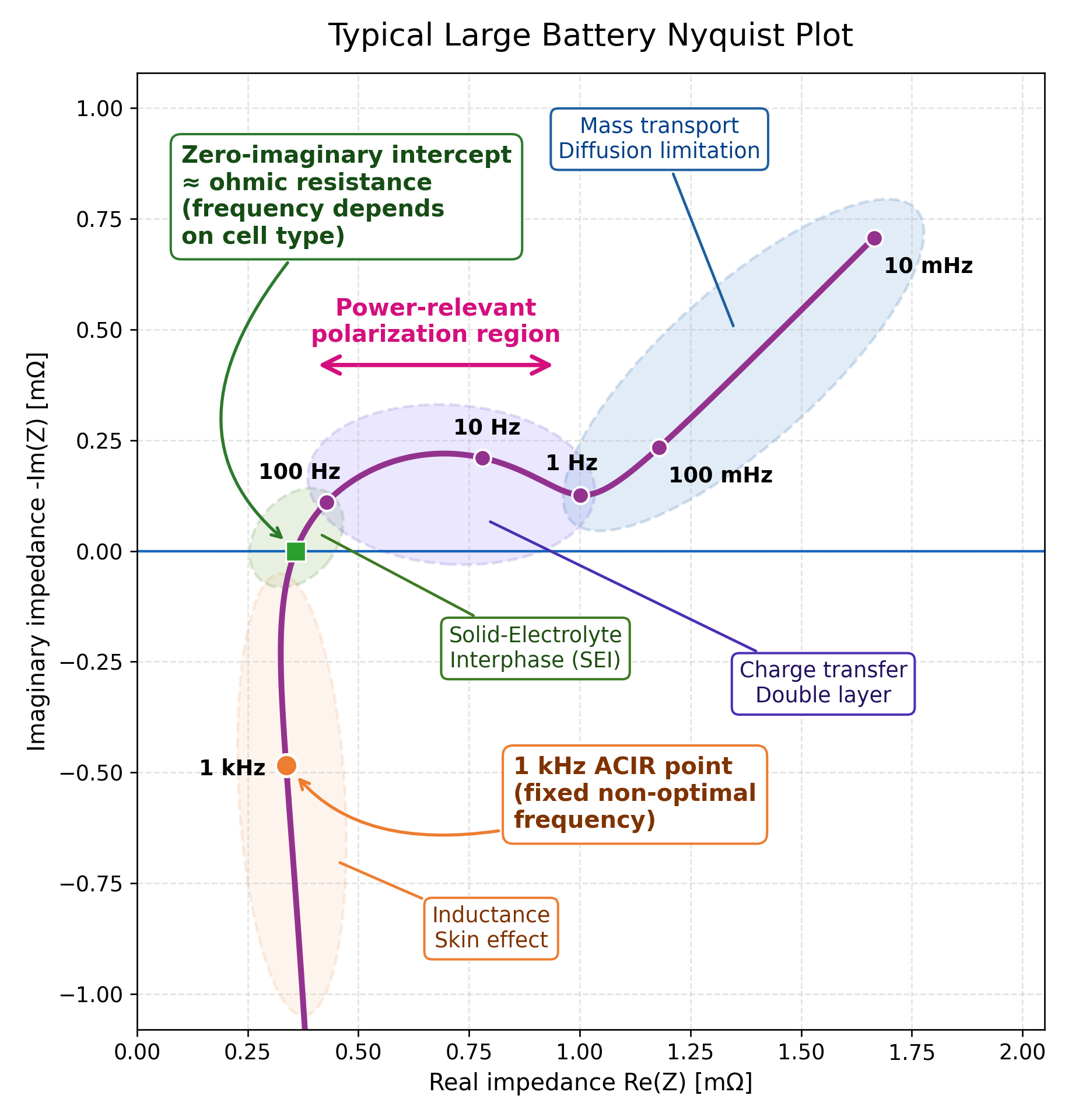
Nyquist Plot Analysis
Each frequency range reveals different degradation mechanisms
What You'll Learn
Workshop Agenda
A 60-minute technical deep-dive into precision battery diagnostics
The 1 kHz Blind Spot
Why conventional single-frequency ACIR can miss important cell-to-cell differences and is inaccurate for large-format cells.
What EIS adds to battery diagnostics
The challenge of large industrial cells and modules characterisation - from Nyquist plots to practical metrics.
Case study: sorting cells for EV battery pack
Sorting cells for a student EV Formula battery pack - how EIS revealed differences between cells with similar capacity and ACIR.
From laboratory data to industrial decisions
Advanced measurement techniques, automation of data processing and decision making, and fields of industrial applications.
Live Q&A with Kolibrik.net and prof. Tomáš Kazda
Open discussion, technical questions, and deeper dives into your specific battery diagnostic challenges outside the main timeframe.
Real-World Impact
Case Study: Powering Formula Student EV
How Kolibrik.net EIS technology and multi-criteria cell screening enabled the TU Brno Racing team to build a top-performing, perfectly balanced battery pack.
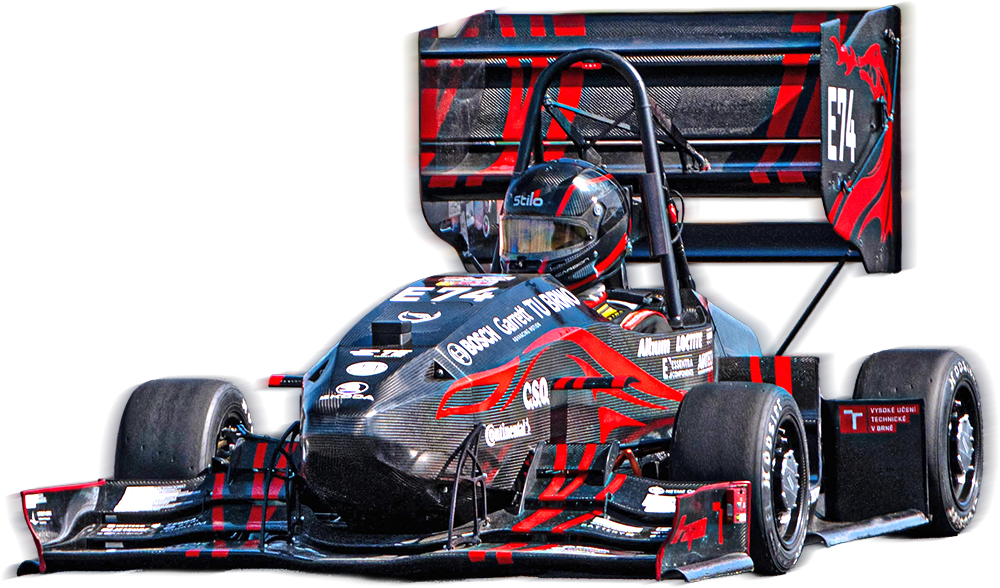
TU Brno Racing's Dragon E74
Formula Student electric racecars demand peak power output of up to 140+ kW while keeping strictly balanced cell-to-cell temperatures and voltages. Matching cells precisely is crucial to avoid limiting overall pack performance.
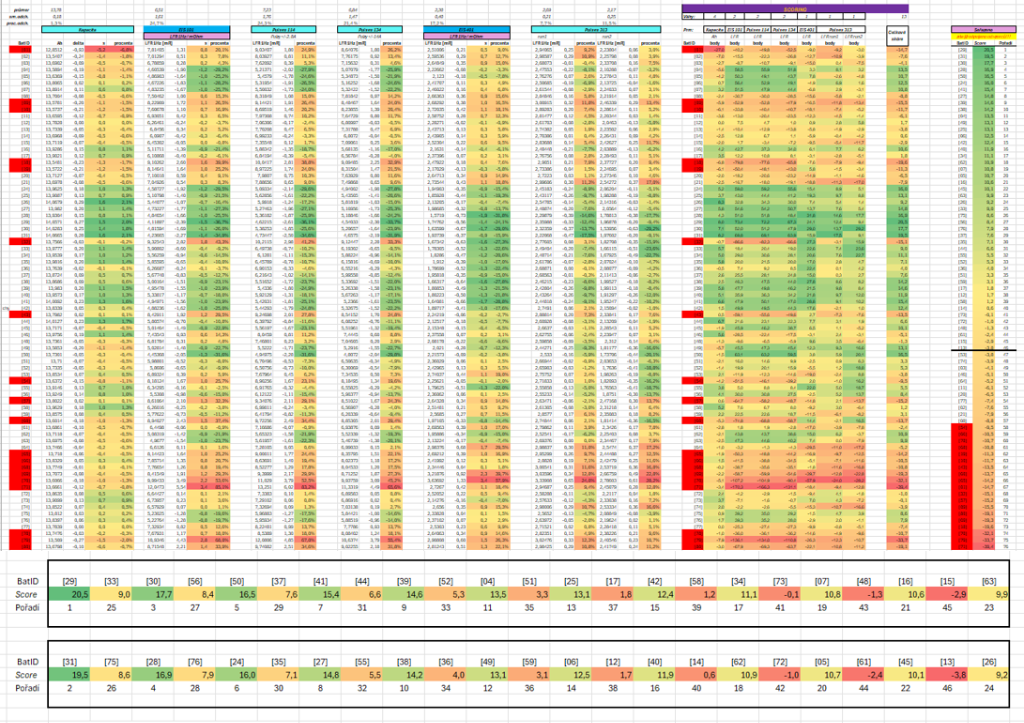
Multi-Criteria Cell Grading
Capacity alone doesn't tell the full story. By measuring EIS across multiple frequencies and using a multi-criteria scoring algorithm, cells were categorized and paired into groups with nearly identical internal impedance profiles.
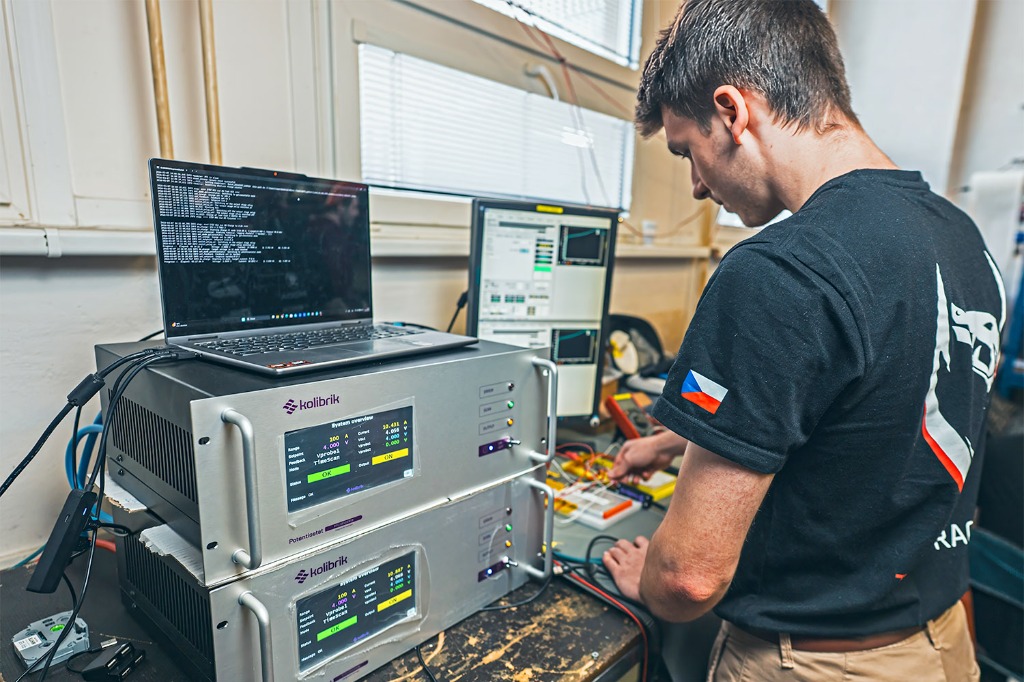
High-Current Potentiostats
Using Kolibrik high-current Potentiostats directly in the team's workshop, students performed fast and highly precise impedance characterization. The automated setup ensured rapid throughput with micro-ohm resolution.
Applications
From the Lab to the Production Line
Kolibrik solutions help bridge the gap between laboratory EIS and practical battery diagnostics. From single-cell research with precision potentiostats to high-current testing of large cells and modules, our platforms combine accurate measurement hardware with advanced impedance analysis.
Production & Quality Control
Fast Impedance Screening
- Selected-frequency EIS for faster screening
- Multi-sine and PRBS excitation for accelerated tests
- Cell sorting and module matching
- Outlier detection in large-format cells
- Incoming inspection and production QA support
R&D & Characterization
Deep Cell and Module Analysis
- Low-impedance cell measurement, μΩ precision
- Ohmic, charge-transfer and transport-related analysis
- DRT and equivalent circuit fitting
- SOC, temperature and ageing comparison
- SOH-related trend indicators
Maintenance & Field Diagnostics
Turning Spectra into Trends
- Periodic module diagnostics
- Impedance trend monitoring
- Detection of abnormal cells or module sections
- Preventive maintenance support
- Insight beyond voltage and temperature data
Second-Life
Smarter Battery Grading
- Used cell and module comparison
- Outlier detection
- Second-life grading workflows
- Dynamic behavior matching
- Complementary data beyond capacity testing
The Kolibrik Approach
Diagnostics, Not Just Data.
We don't just push a single box; we analyze your problem. Whether you need R&D-grade precision or production-line speed, our hardware is built to handle high currents and amplitudes, delivering micro-ohm accuracy regardless of cell size.
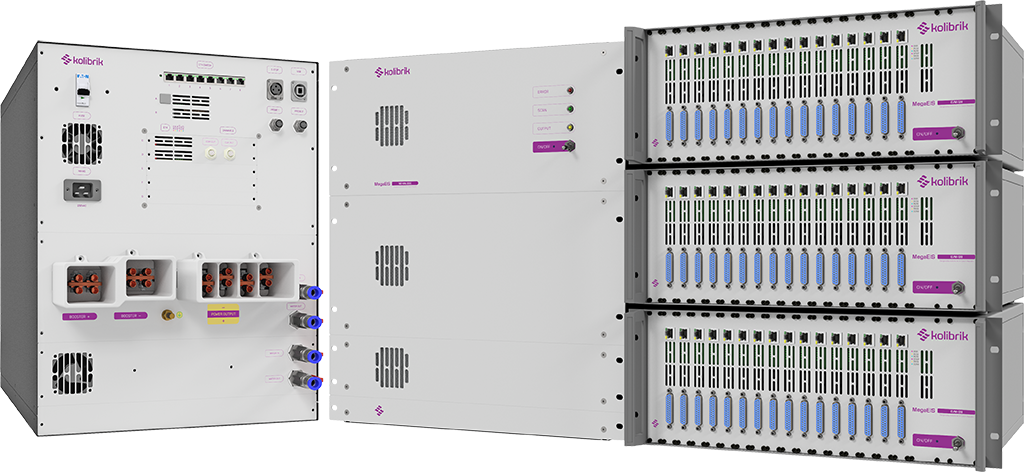
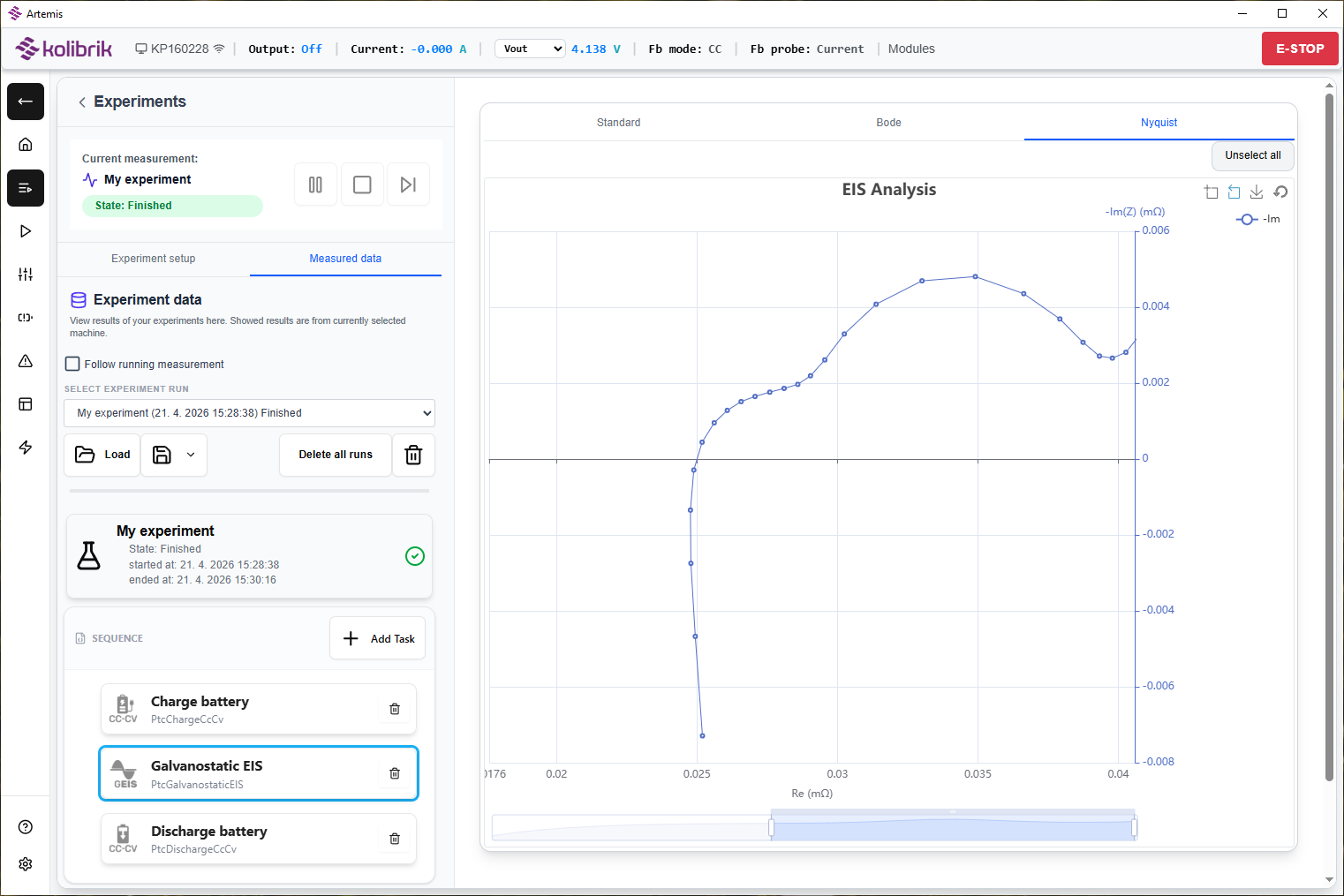
Kolibrik MegaEIS™ — parallel multichannel system with integrated EIS
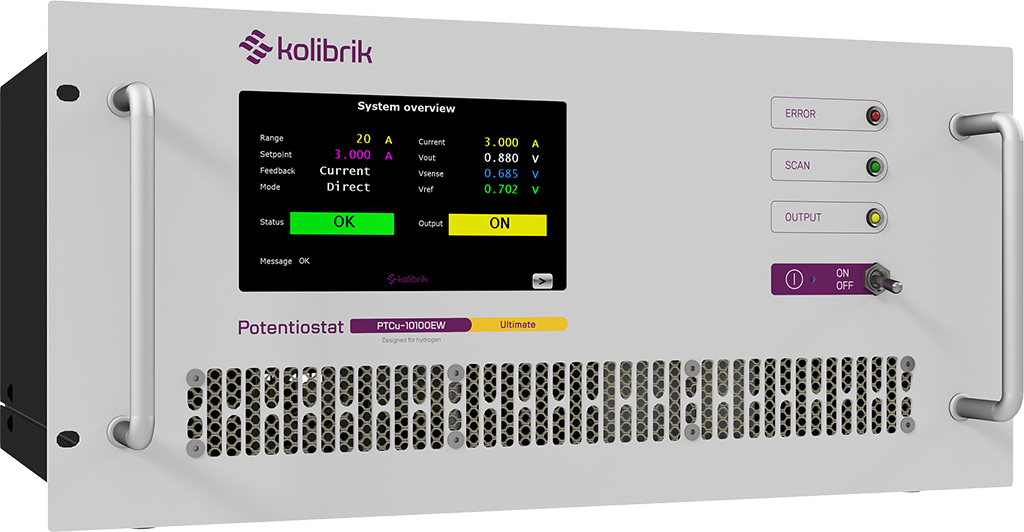
Potentiostat Ultimate PTCu-10100EW with integrated EIS
From a single high-current potentiostat to rack-scale MegaEIS™ arrays, every instrument shares the same measurement philosophy: capture the full impedance spectrum where it matters, not a single frequency shortcut.
The High-Current Potentiostat combines 4-quadrant cycling with in-module diagnostics; parallel channels scale that capability to entire packs without sacrificing μΩ-level resolution.
Parallel Multichannel
MegaEIS
True parallel EIS across hundreds of channels for large battery pack testing. Includes bi-directional power and booster options.
4-Quadrant Potentiostat
High-Current Potentiostat
Heavy-duty battery potentiostats with integrated high-precision EIS. Scalable across three lines: Ultimate, Core, and Essential.
Kolibrik Measurement Software
Artemis
The measurement and control app for full control over fuel cells, batteries, electrolyzers, and supercapacitors.
Webinar Team
Meet our Hosts & Guests
Webinar Host
Meet the Sales & Marketing Director from Gamry Instruments moderating the session.


Chris Beasley
Leading Gamry's charge with the eQCM 10M. Specializes in redox-active nanoparticles, electrochemical quartz crystal microbalances, and supporting academic and industrial partners in solving complex electrochemistry challenges.
Guest Specialists
Distinguished researchers and industry experts sharing key diagnostic insights.

Tomáš Kazda
Research of electrochemical power sources — mainly Li-ion, post-lithium-ion battery systems and other battery systems and things connected to lithium (recycling, mining).

Jiří Libra
16+ years of electrochemical know-how. We design electronics from scratch and bridge the gap between “off-the-shelf” and “impossible”.